
UC Riverside-led study confirms altermagnetism in hematite
Researchers from the University of California, Riverside, in collaboration with Oak Ridge National Laboratory, have confirmed a recently identified form of magnetism known as altermagnetism in hematite, a common iron oxide better known as rust. The findings, published in Physical Review Letters, establish hematite as a scalable and promising platform for future energy-efficient electronic technologies.
For more than 75 years, physicists understood magnetism as either ferromagnetic, where atomic spins align to produce a net magnetic field, or antiferromagnetic, where spins alternate and cancel out. Altermagnetism, identified in 2022, represents a third category. It combines zero net magnetization with spin-polarized electronic behavior, an unusual pairing that could enable faster, denser, and more efficient information processing.
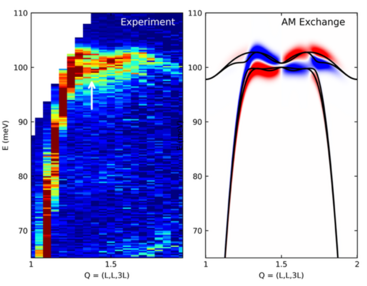
The study was led by Qiyang Sun, a UC Riverside Ph.D. alumnus and postdoctoral researcher at Oak Ridge National Laboratory, and Chen Li, a professor of mechanical engineering and materials science and engineering at UC Riverside. Using inelastic neutron scattering at the Spallation Neutron Source, the world’s brightest neutron source, the team directly observed signatures of altermagnetism in hematite.
“Altermagnetism behaves very differently from classic magnetic materials,” said Li. “By identifying it in a widely available and stable material like hematite, we open new opportunities for scalable technologies.”
Unlike previously studied altermagnetic materials, which were limited to metals and semiconductors, hematite is the first insulating oxide shown to exhibit altermagnetism. It also displays a rare “g-wave” altermagnetic state, with a richer spin texture than the more common d-wave type. This distinction may enable new ways to control electronic and magnetic properties at the quantum level.
Hematite’s practical advantages further strengthen its potential. The material is earth-abundant, non-toxic, and remains magnetically stable at temperatures up to approximately 960 kelvin, or about 687 degrees Celsius. These properties make it a strong candidate for real-world applications, including spintronics, an emerging field that uses electron spin rather than charge to store and process information.
“Materials that combine stability, scalability, and novel quantum behavior are essential for advancing next-generation spintronics,” said Sun. “Hematite offers a compelling foundation for devices operating at room temperature and beyond.”
By demonstrating altermagnetism in a common material, the study lowers barriers to experimental validation and device development. The findings position hematite as a bridge between fundamental physics and applied engineering, advancing efforts to design ultrafast, energy-efficient technologies for computing and communications.
The work reflects a collaboration between UC Riverside’s Department of Mechanical Engineering and Department of Materials Science and Engineering, along with national research laboratories. It also reinforces the Marlan and Rosemary Bourns College of Engineering’s commitment to interdisciplinary research.
The research was supported by the U.S. Department of Energy’s Office of Science, Basic Energy Sciences program.