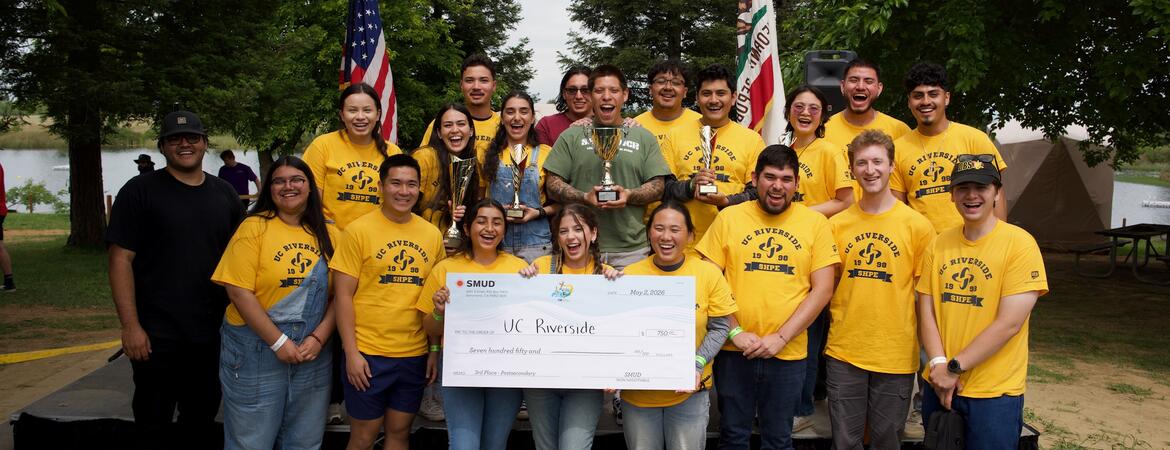
Before competition began at Rancho Seco Recreational Area in Sacramento, UC Riverside students gathered around a boat they had spent months designing, rebuilding, and testing.
For members of the Society of Hispanic Professional Engineers (SHPE) Solar Boat team, the moment reflected far more than race day. It represented late nights in the workshop, failed prototypes, fundraising efforts, and months of collaboration.
By the end of the weekend, the team returned from the Sacramento Municipal Utility District (SMUD) Solar Regatta with five awards, including third place overall and the competition’s Grit & Gumption Award.
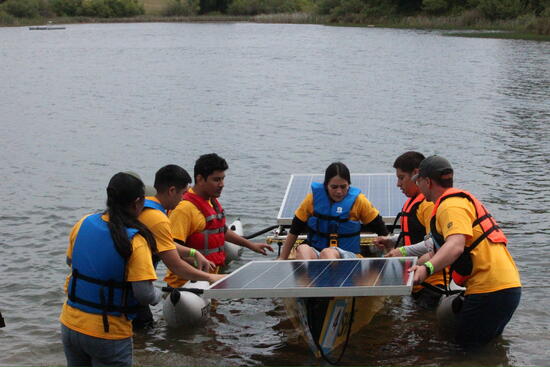
Held May 1-2, the annual regatta brings together high school, college, and university teams from across California to design, build, and race fully solar-powered boats. Teams compete in sprint, endurance, maneuverability, and technical events that test engineering performance, efficiency, and teamwork.
This year, UCR competed against teams from institutions including Cal Poly Pomona, Chabot College, City College of San Francisco, Chico State, Folsom Lake College, San Francisco State University, and Sierra College.
UCR earned five awards at this year’s regatta, including third place overall in the Cup Championship, which combines scores from races, technical evaluations, sustainability metrics, design categories, and team participation.
The team also received the Presentation Award for achieving the highest scores across sustainability, technical design, solar integration, teamwork, and overall presentation categories.
Additional honors included the Best Video Award for the team’s boat design video, the Judges Award, and the regatta’s Grit & Gumption Award, which recognizes teams that demonstrate resilience while overcoming challenges throughout the competition season.
The recognition marked another milestone for a project that has expanded rapidly over the past two years.
Last year, about 10 students attended the competition. This year, nearly 45 students participated in construction days throughout the season, and 20 students traveled to Sacramento to compete. More than half of the attending students identified as women, reflecting the team’s emphasis on collaboration and inclusion within engineering.
“What originally began as a small group of friends with a shared goal of creating a hands-on engineering experience has grown into a hub for more than 40 engineering students from all backgrounds,” said Joshua Rojas, a fourth-year mechanical engineering transfer student and former project lead.
Rojas said the experience pushed students beyond classroom learning.
“Solar Boat taught me far more than engineering,” he said. “It taught me how to lead with purpose, secure funding, and turn a vision into an award-winning reality.”
The project brings together students from mechanical engineering, electrical engineering, and computer science to build a competitive solar-powered vessel while gaining hands-on experience in design, fabrication, and systems integration.
Throughout the academic year, students worked in specialized subteams focused on software systems, electrical efficiency, and mechanical performance.
The software team developed a wireless telemetry system capable of transmitting real-time performance data, including voltage, speed, GPS coordinates, and system orientation. Students also designed a solar tracking system that automatically adjusts panel positioning for optimal sunlight exposure.
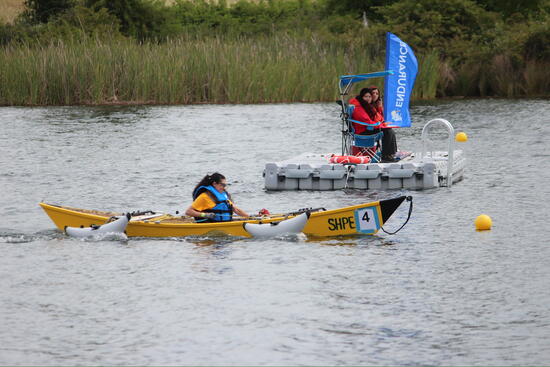
Mechanical engineering students refined the boat’s rudders, steering systems, and motor mounts through repeated rounds of prototyping and testing. Many components were redesigned multiple times using 3D-printed mockups before final assembly. The hull was reinforced with fiberglass and waterproofed with epoxy resin to improve durability and reduce drag.
Meanwhile, the electrical team focused on maximizing system efficiency during endurance events, where strict battery and power limits required careful energy management.
“One of the biggest improvements came during the endurance race,” team members said in a project summary. “By improving power distribution and reducing energy loss throughout the system, we significantly improved the boat’s endurance performance compared to previous years.”
For incoming project lead Anahi Huerta-Garcia, a third-year mechanical engineering student, the project provided experience difficult to replicate in a traditional classroom setting.
“Solar Boat introduced me to hands-on experience and connections that I had not experienced in the classroom,” Huerta-Garcia said. “It exposed me to real-world engineering applications, strengthened my communication skills, and boosted my confidence as an engineer.”
The project operates under SHPE at UCR, an interdisciplinary engineering organization focused on professional development, mentorship, and increasing representation in STEM fields. The organization is advised by Carlos Gonzalez, director of UCR Mathematics, Engineering, Science Achievement (MESA) Programs.
Looking ahead, students plan to expand the project’s environmental research applications by incorporating water quality monitoring systems capable of measuring oxygen and nitrogen levels to help predict algae blooms and monitor environmental conditions.
For many students, however, the project’s greatest impact has been the community built along the way.
What began as a small student initiative has grown into a collaborative space where future engineers learn not only how to build a solar-powered boat, but how to adapt, solve problems, and lead together.