At the University of California, Riverside, undergraduate research is designed to prepare students for discovery. For some, it also becomes a pathway to national recognition.
Four UC Riverside students and alumni have earned National Science Foundation Graduate Research Fellowships, one of the nation’s most competitive honors for emerging researchers in science, technology, engineering, and mathematics.
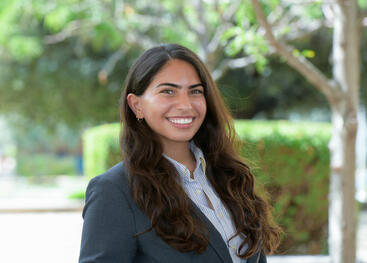
The 2026-2027 recipients include Jonah Damian, a biochemistry major, and Janna Soliman, a bioengineering major and senior Chancellor’s Research Fellow at UC Riverside. Alumni recipients include Hannah Moore, a 2025 chemistry graduate now at the University of California, Berkeley, and Minh-Huy Tran, a 2024 bioengineering graduate now at Stanford University. Selected from nearly 14,000 applicants nationwide, the fellows were recognized for their intellectual merit and potential to contribute to scientific innovation. NSF awarded approximately 2,500 fellowships this year.
Their achievements reflect the growing culture of undergraduate research and mentorship at UC Riverside, particularly within programs that support students pursuing advanced study in STEM fields.
For Soliman, the award represents years of research, mentorship, and academic growth at UC Riverside.
“The NSF GRFP will support me as I pursue a Ph.D. in bioengineering at UC Santa Barbara,” Soliman said. “Receiving this award reflects months of careful revision and thoughtful storytelling across both my personal and research statements.”
She credited mentorship as a defining part of her undergraduate research experience.
“I am especially grateful to my PI, Dr. Joshua Morgan, whose mentorship has been instrumental throughout my writing process and over the past three years of my undergraduate career,” Soliman said. “His guidance not only encouraged me to apply for the NSF GRFP, but also inspired my long-term goal of becoming a professor.”
Morgan, an associate professor of bioengineering at UCR, said Soliman distinguished herself through both technical growth and enthusiasm for discovery.
“It has been a privilege to work with Janna over the past several years,” Morgan said. “Over that time, I’ve seen her change in many ways: developing a scientist’s rigor and an engineer’s creativity. What hasn’t changed is her enthusiasm for research or her relentless, unstoppable optimism. I’m very excited to see what she accomplishes in the next stages of her career.”
Soliman began her undergraduate research journey through the UCR RAMP program, funded by the California Institute for Regenerative Medicine’s COMPASS initiative. Designed to expand pathways into regenerative medicine research careers, the program provides students with sustained mentorship, research and communications training, and financial support.
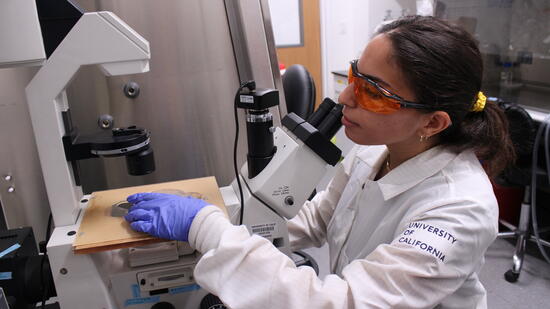
As part of the program’s second cohort, Soliman received two years of support for faculty-mentored undergraduate research, including a research stipend, tuition support, laboratory supplies, and conference travel funding. The support enabled Soliman to pursue sustained research while expanding her professional and academic experience beyond the classroom.
“Programs like RAMP are designed to give students early access to meaningful research experiences, mentorship, and professional development,” said Huinan Liu, professor of bioengineering and principal investigator for the UCR RAMP program. “Janna’s accomplishment demonstrates what students can achieve when they are given the opportunities and resources to grow as researchers.”
Both Soliman and Damian engaged with the Center for Undergraduate Research and Engaged Learning (CUREL) over the past two years, beginning with applications for institutional endorsement for the Goldwater Scholarship. Alongside research, each pursued opportunities that extended learning beyond the laboratory.
Damian developed and taught a student-led R’Course on 3D printing, creating hands-on learning opportunities for fellow students. Soliman continued to build her research portfolio while serving as a senior Chancellor’s Research Fellow, balancing laboratory work with leadership and mentorship.
Together, their experiences reflect UC Riverside’s emphasis on early research engagement, interdisciplinary collaboration, and hands-on learning opportunities for students pursuing careers in science and engineering.
That culture is increasingly producing students who move directly from undergraduate research into nationally competitive graduate programs and fellowships.
The NSF Graduate Research Fellowship Program provides three years of financial support over a five-year period, with a total award value of $159,000. Established in 1952, the program has supported more than 70,000 fellows, including scientists, engineers, entrepreneurs, and Nobel Prize winners.
For these students and alumni, the fellowship is both recognition and momentum, as well as affirmation that the work they began at UC Riverside is preparing them to shape the future of science and engineering.