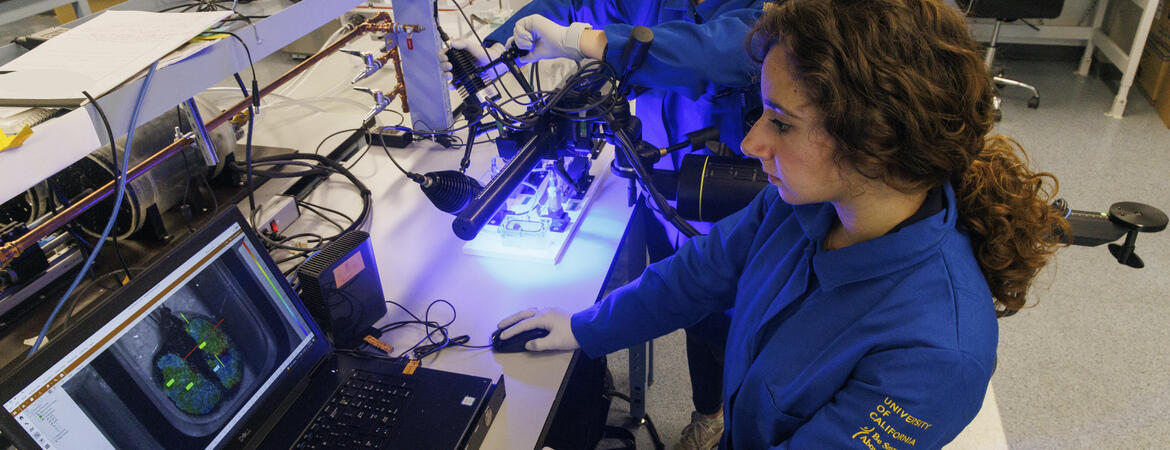
Researchers at the University of California, Riverside, are advancing what researchers describe as the first continuously ventilated, structurally representative three-dimensional human lung model informed by both organ- and tissue-level experimental data.

Led by UC Riverside mechanical engineer Mona Eskandari and trainees in UCR’s bioMechanics Experimental and Computational Health (bMECH) Laboratory, the research was highlighted at the 2025 SIMULIA Americas Users Conference, where postdoctoral researcher Dr. Arif Badrou presented new findings from the international Living Lung Project.
The research combines experimental lung testing with advanced structural simulation software to create a continuously ventilated, three-dimensional model of the human lung. The project is part of a broader collaboration with Dassault Systèmes and builds on the success of the company’s earlier Living Heart Project.
“Building a model of the human lung is really difficult,” Badrou said in a recent feature published by Dassault Systèmes. “The lungs affect different aspects and different levels, micro and macro levels, and simulating and modeling all this interaction can be very difficult.”
Lung disease remains one of the leading causes of death worldwide, contributing to millions of deaths annually and placing a major burden on health care systems. Yet pulmonary biomechanics research has historically lagged behind fields such as cardiovascular medicine and neurology.
To address that gap, Eskandari invented a custom breathing mimicry apparatus that simulates physiological breathing patterns in human and animal lungs. The system is interfaced with digital image correlation techniques to measure pressure, volume, and tissue strains in real time to capture complex lung deformations during breathing.
Those experiments generate the data needed to inform and validate detailed computational simulations developed using SIMULIA Abaqus software.
In a recent study published in PLOS Computational Biology, the team reported development of the first continuously ventilated, structurally representative three-dimensional human lung model informed by both organ- and tissue-level experimental data.
The model reproduces critical mechanical behaviors of the lung, including pressure-volume relationships and regional strain patterns that occur during breathing. Researchers say the framework could eventually support studies of diseases such as emphysema and chronic obstructive pulmonary disease, or COPD, while also improving mechanical ventilation strategies for critically ill patients.
The project represents a major milestone for the University of California, Riverside. In 2022, related work from Eskandari’s lab was recognized among the University of California system’s “12 Incredible UC Research Breakthroughs,” the only honoree from UC Riverside that year.
Eskandari said the long-term vision is to move from generalized lung models toward patient-specific simulations that could one day support precision medicine.
The work is supported in part by a Dassault Systèmes U.S. Foundation Grant and conducted as part of the Living Lung Project. Additional support includes the Opportunity to Advance Sustainability Innovation program, the State of California Climate Action Through Resilience Program, and the National Science Foundation Graduate Research Fellowship Program.